Tuesday, February 12, 2013

Snapdeal starts selling Automobiles online!


Sent to you by vishal via Google Reader:


via Trakin' the india business buzz by Arun Prabhudesai on 1/22/13

Snapdeal.com, one of the leading Indian ecommerce portal, has now started offering automobiles on sale online. They have forged a partnership with Mahindra & Mahindra to offer range of their two-wheelers. This is probably for the first time that a mainstream online retailer is offering automobiles for sale online.
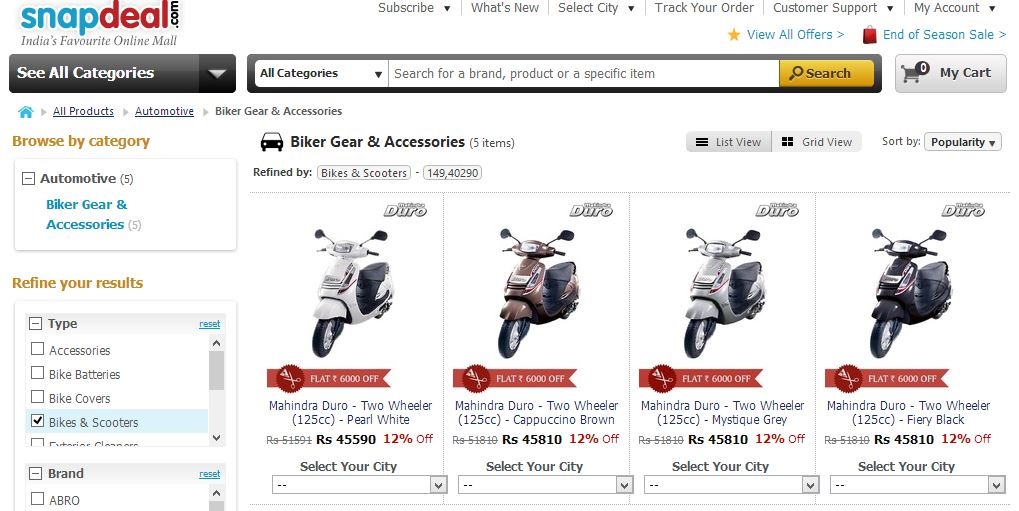
Snapdeal Auto offers thumb | Snapdeal starts selling Automobiles online!

With a product like automobiles, the sales cycle is obviously different, but from what Snapdeal has detailed the entire process well and have taken care of nearly everything that a potential buyer may want to know.

Because Snapdeal has forged a direct partnership with Mahindra & Mahindra, they are also able to offer some really good discounts and deals on the vehicles on offer.

For eg: Mahindra Duo (125 cc) is offered at a price of Rs. 40,900, which includes a discount of Rs. 6000. From what I know, it will be tough for a offline retailer to offer that kind of discount. In addition to this, snapdeal is offering additional 2 years warranty (along with regular 2 years from M&M), which makes the deal all the more appealing for the potential buyer.
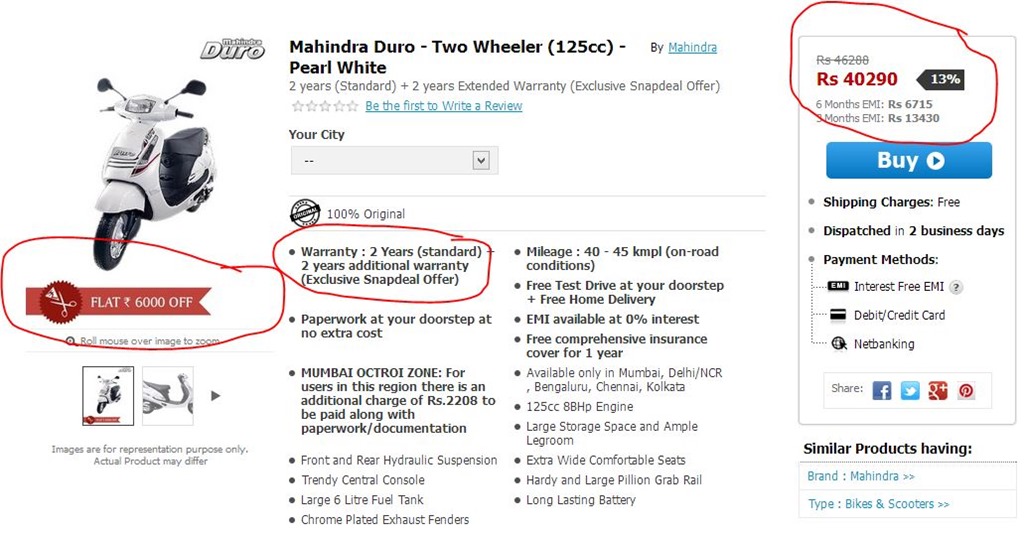
mahindra Dua Discount thumb | Snapdeal starts selling Automobiles online!

Also, snapdeal.com customers can buy the vehicle at 0 percent interest rate with 3 and 6 months EMI.

Process for buying Automobile on Snapdeal

  1. Customers will have to call Snapdeal Customer support and book a Test Drive. A Mahindra executive will arrange it in 3 days. Once a test drive is done, you can complete your online purchase.
  2. After online order is placed, Mahindra executive will visit your home to finish the paperwork and formalities.
  3. Within a week, vehicle will be delivered at the door-step of the customer.

Our Take

While, many buyers may not be comfortable buying automobiles online, given that customers are directly in touch with Mahindra executive should put most of the fears to rest. Additionally, the discounts and goodies offered online are quite tempting and customer does stand to save good amount of money.

If Snapdeal and Mahindra are able to execute the entire process of buying and delivery of vehicles smoothly without delays, I am sure the trend of buying automobile online will catch one.

Would love to hear what the readers think of this?

[Note to Snapdeal: You guys need to put the prices of vehicles correctly. While on the listing page (see first screenshot) the price shown is Rs. 45,590/-, if you visit the actual product display page (see second screenshot), it shows Rs. 40,290/-. That is really a serious mistake!]

The post Snapdeal starts selling Automobiles online! appeared first on India Business & Technology Buzz.


Things you can do from here:


Online Shopping Trends in India in 2013


Sent to you by vishal via Google Reader:


via Trakin' the india business buzz by Arun Prabhudesai on 2/2/13

Google has released a video depicting the online shopping trends in India currently and what is expected of the online shopping growth in future. The video is based on Google search trends data and consumer research that happened in collaboration with Analyst firm TNS.

online shopping growth trends thumb | Online Shopping Trends in India in 2013 [Google Video]

According to the findings, 2012 turned out to be the inflection point for Online shopping in India, where Indian online users went beyond online tickets, which was traditionally the most popular category for ecommerce in India. Online shopping grew by over 128 percent in 2012 compared to previous year.

Online Shopping Trends Research Highlights

  1. 9 out of 10 online buyers will spend more money in 2013 as compared to previous year.
  2. Non Metro buyers are increasingly buying online with their contribution increasing much more than the metro online buyers.
  3. Online buyers will use Mobile Phones and tablets more to make purchases online than what they did previously.
  4. Among the all categories, Apparels and accessories category witnessed the most growth and it will surpass even electronics in 2013.
  5. As compared to electronics, emerging categories like baby products, health and nutrition are seeing more growth
  6. Travel and ticketing will remain the most popular category for purchases in 2013 and beyond. Most of the new shoppers have made purchases in travel category first and then moved to other categories
  7. Top drivers of online shopping growth are faster delivery, Cash on Delivery facility, discounted rates, access to branded products and cash-back guarantee on faulty goods.
  8. Top reasons that prevented online buyers from making purchases online were inability to touch and feel, inability to return goods, longer delivery times, need for posting financial details and inability to bargain
  9. Gaining consumer trust remains one of the most important drivers for online shopping growth in India

Online Shopping Trends Video

The post Online Shopping Trends in India in 2013 [Google Video] appeared first on India Business & Technology Buzz.


Things you can do from here:


15 Apps Every Entrepreneur Should Have!

15 Apps Every Entrepreneur Should Have!
Source: trak.in
This is a collection of some of the most essential apps that entrepreneurs should have in their kitty!
 

Wednesday, January 2, 2013

Want to Break Habits? Make Some

Coming out of a habit is not an easy task. All of us have habits that we want to get away from - but its hard! I was listening to an HBR ideacast few days ago and really liked some thoughts. The idea behind the whole thing was that its not as important to feel bad about your habit and convince yourself that "I will not do it". But, it is important to train yourself on "This is what I will do" when I am about to become the victim of my habit. So, if you want to quit cigarette  - don't convince yourself again and again on "I wont smoke next time". But, tell yourself what will you do when you want to smoke - i.e. train yourself on "I will chew a gum" next time I want to smoke. This trains the mind that the right sequence to follow is not to smoke but to chew a gum. Soon, you mind will be asking for gum and not smoke.

So, break the bad sequence by training yourself on an alternate sequence and not by simply stopping to do the old one.
Using Social Media for Sending Wishes

I got up in the morning thinking that because I will have have more time this year, why not start the year by hand-picking people and sending them a "twitter" like (super short - less than a sentence) personal note to wish them on new year. We all know that nothing parallels hand written note. But, still, people these days understand that it will be hard to write and mail 100 cards on every event. However, did you ever try posting on your linkedin or facebook "Happy New Year" and watch how many people respond back to you. I tried that shortcut over the last couple of months and was surprised that I seldom get a response from people! However, today, the response rate was almost 60-70% ( I gave benefit of doubt to some others who must still be on vacation or are on a different time zone).

This painted a picture for me. It feels like using so called "Social Media" to say "Happy New Year" resembles something we all probably did at some point in our lives. I still remember putting up a string with weaved paper alphabets that collectively meant "HAPPY DIWALI" right above the front door of my house. In retrospect, hanging that string in front of my door did not automatically mean anything to people. Infact family/friends who did not visit me that day (or for the next 2 days) did not even see that sign because it was gone by then. So, if I wanted to wish someone, I had to visit them or atleast call them. I feel putting that "sign" against your Social Media handles is exactly like that. It does not mean anything to anyone - except that is shows you are happy - only to people who visit your page before that sign is buried under other updates. There is no personal touch to it and hence you hardly get a response. So, while social channels are good push medium for us in general (we update and others get to know) it certainly does not act that way when we want to push wishes. 

So, I think a short simple email is definitely much more personal and should be used - instead of putting up signs on social media.

Sunday, September 16, 2012

American Football Teams

AFC East
Buffalo Bills - New York
New York Jets - New Jersey
Miami Dolphins - Florida
New England Patriots - Massachusetts

AFC North
Baltimore Ravens - Maryland
Cleveland Browns - Ohio
Cincinnati Bengals - Ohio
Pittsburgh Steelers - Pennsylvania

AFC South
Houston Texans - Texas
Indianapolis Colts - Indiana
Tennessee Titans - Tennessee
Jacksonville Jaguars - Florida

AFC West
Denver Broncos - Colorado
Kansas City Chiefs - Missouri
San Diego Chargers - California
Oakland Raiders - California

NFC East
Dallas Cowboys - Texas
Philadelphia Eagles - Pennsylvania
Washington Redskins - Maryland
New York Giants - New Jersey

NFC North
Minnesota Vikings - Minnesota
Green Bay Packers - Wisconsin
Detroit Lions - Michigan
Chicago Bears - Illinois

NFC South
Tampa Bay Buccaneers - Florida
Atlanta Falcons - Georgia
New Orleans Saints - Louisiana
Carolina Panthers - North Carolina

NFC West
Arizona Cardinals - Arizona
St. Louis Rams - Missouri
San Francisco 49ers - California
Seattle Seahawks - Washington

Sunday, September 9, 2012


Link to Article: https://www.bcgperspectives.com/content/articles/retail_digital_economy_retail_2020_ten_trends/print

Ten Trends That Are Reshaping the Retail Industry
Retail 2020 by Pierre Mercier, Rune Jacobsen, and Andy Veitch August 09, 2012
1. Empowered, Discriminating Consumers. With access to product information, price comparisons, and user reviews, consumers can make informed decisions—and widely share their complaints. For retailers, the bar is rising, and they must add meaningful value to what shoppers can find for themselves, both online and in stores.

2. Ubiquitous Connectivity. With the Internet available at work, at home, and on the go, consumers will be full-time shoppers and most purchases will have some online aspect. Smartphone numbers will be in the billions by the end of this decade.

3. Buying Local, Going Green. Shoppers want to consume in a responsible, sustainable way. They want to purchase from organic and local vendors, and want proof of product origins. But it remains to be seen whether they will pay more for green products.

4. Explosion of Consumer Data. Points of sale, social media, corporate websites, and tracking URLs are generating an enormous amount of consumer data, but few retailers are capable of fully exploiting the potential value of this input. It will take time, because the volume of data is still growing faster than the ability to process it.

5. New Age of Marketing. With more data on customers, their online activities, and purchasing patterns, retailers will be able to create more targeted marketing campaigns—once they figure out how to mine the insights. This will require experimentation and calibration—and consumers will have limited tolerance for misguided marketing efforts.

6. Scientific Retailing. By applying smart algorithms and deep, data-driven analytics to the unprecedented volume of data from multiple sources, companies can optimize all aspects of their business, including inventory levels, pricing, warehouse space, assortments, shelf displays, and staffing.

7. Growing Retailer Power. The top five grocery stores in the U.S. now have a 33 percent share of the market—up from 25.5 percent in 2000. As their spending increases, they have more clout with suppliers. But in several categories, the increased retailer power may tilt toward large Internet players or marketplaces as their growth outpaces the brick-and-mortar competition.

8. Maturing Retail Technologies. A wide range of maturing technologies is allowing companies to streamline backroom functions and increase efficiency, helping to offset higher labor costs. While these are part of the solution for brick-and-mortar retailers, they won’t fundamentally alter the relative economics between store-based and online transactions.

9. Blurring Boundaries Among Channels, Formats, and Brands. CVS is selling fresh food, grocery stores have in-house bank branches, and bookstores have cafés selling Starbucks coffee. Rather than thinking in terms of channels, consumers are simply opportunistic. If they have a need and can fulfill it easily and conveniently, they will.

10.Challenged Store Economics. The rise of online buying is eroding store traffic, forcing retailers to rethink their costly real-estate assets and merchandising formats. How valuable will bricks and mortar be in the future and for what role? Dynamics will play out very differently by category and location.