Sunday, January 12, 2014

I’ve Seen The Future Of Health Tech And It’s Going To Improve Your Life In 2014

I've Seen The Future Of Health Tech And It's Going To Improve Your Life In 2014
http://feedly.com/k/1guZ65q

I just returned from the most exciting Consumer Electronics Show I've ever covered. Thanks to extraordinary demand for gadgets that make us healthier, stronger, and smarter, the technology industry is putting some serious brain power behind the next generation of wearable health devices. Over the next year, a torrent of new devices is hitting the market to provide automated elite coaching, a pocket-sized clinical lab, and your own personal assistant.

Labs In Your Pocket

It seems that nearly every time I rush head-first into a new diet or exercise program, I find months later there's some crucial oversight that's holding back my progress or actively destroying my body. Exasperated in frustration, I drag myself to a clinic for expert diagnostics, only to discover simple advice I should have been following from the beginning.

Now, nearly every expensive lab test I've gotten over the past year is coming to the delightful convenience of my smartphone. The Sensoria smart sock correctly diagnosed that I make the runner's rookie mistake of heel striking, leading to a workout-stopping knee pain (available this spring).

Valencell's PerformTech in-ear heart-rate monitor calibrated my V02Max (a common measure of endurance) in a nearly painless five minutes of light stair-stepper work on the CES show floor (available now). The results were within 5 percent of lab-test results I received months earlier and helped me know that two months of running San Francisco's hills are probably paying off.

Quality rest is just as important as hitting the gym. The Basis B1 wristwatch, Sleeprate app, and Withing's Aura bed pad will diagnose the quality of the major stages of sleep, including crucial REM cycles.* I got a preview of Sleeprate's heart-rate-monitor-powered app, and apparently I've got a nasty restless sleep cycle (Basis update coming January 21, Sleeprate January 23rd, and Aura in the spring).

Unlike a lab test, these devices can follow you wherever you go, ensuring you actually follow through with the advice. Many of us work so hard at self-improvement; it's nice to know that our time isn't going to waste.

Automated Elite Coaching

The defining feature of the world's sharpest coaching minds is a broad novel strategy that is meticulously applied to each student. The delicious replicability of elite coaching makes it ripe for automation.

While last year was all about fitness gadgets that monitor activity, "what's going to happen next is teaching technique," said Ruth Thomason of Cambridge Consultants. Cambridge was showing off the ArcAid basketball free-throw technique video analyzer. Normally available to college sports teams with budgets larger than the entire Humanities Department, this kind of video technology could bring elite coaching to the masses.

The marathon-enthusiast fitness company, Polar, is releasing what claims to be the most advanced training watch on the market. The Polar V800 meticulously tracks heart rate to advise athletes when they're overtraining, analyzed through a free online web app, Polar Flow (available in April).

There's also hope for my fellow ADHD brethren: Interaxon's Muse headband is like a mind-reading meditation coach. Using classic techniques from the field of neurofeedback, the behind-the-ear mounted EEG device measures brainwaves to coach users into a state of meditative peace. Unlike its competitor, Neurosky, which is mostly used for brain-controlled computing (and women who love to wear rotating cat ears in San Francisco), the muse will track improved mindfulness over time.

In the same way online education is bringing the teachings of world-class professors to anyone with an Internet connection, the future of health tech will be to essentially roboticize elite coaches in the devices we wear on our bodies.

The Digital Mother

"Sit up straight and brush your teeth!" Sometimes, we know exactly what we're supposed to do, but just aren't very good at following through. The latest health tech is here to gently nag you into better health.

The Lumo Lift is a vibrating shirt pin that buzzes whenever it detects slouched shoulders. It's pretty much impossible to answer 5,000 emails a minute and remember to sit up straight for eight hours. This little guy helps you remember (available in the spring).

For objects around the house, the aptly named "Mother" device imbues everyday objects with the nagging power of our lovely moms. Sen.se's Mother interacts with satellite "cookies" that know when and how an object is being used; for instance, whether a bottle of pills is being picked up and poured upside down. The same goes for a jar to water the plants (available in the spring).

2014 is going to be an exciting year for digital health. For years, technology has conspired to transform our upright bodies into hunched-back zombies. Now, it can make us all ubermen. Bring on the gadgets!

shared via http://feedly.com

Sunday, January 5, 2014

26 amazing startups you need to watch in 2014 | VentureBeat | Business | by Dylan Tweney

26 amazing startups you need to watch in 2014 | VentureBeat | Business | by Dylan Tweney
http://feedly.com/k/1lxAXwa

shared via http://feedly.com

Thursday, January 2, 2014

It might cost you $39K to crowdfund $100K under the SEC’s new rules

It might cost you $39K to crowdfund $100K under the SEC's new rules
http://feedly.com/k/1gss5aO

Shutterstock

On October 23, 2013 the Securities and Exchange Commission (SEC) issued the proposed rules for Regulation Crowdfunding.  The 585-pages included an explanation of the rules, the feedback it received, and a cost/benefit analysis.

A cost/benefit analysis is common in many regulations to give the public an estimate of the costs associated with implementing the proposed regulation.  It answers the question, "Do the costs outweigh the benefits?"  For Regulation Crowdfunding it sheds light on the question, "How much will it cost to raise money via crowdfund investing, and how do I keep it to a minimum?" Here's a closer look at what that analysis tells us.

The Background

The legislation requires that the selling of crowdfund securities take place on registered websites.  The websites hosting the transactions are known as funding portals or broker dealers.  These entities must register with the Securities and Exchange Commission (SEC) and the Financial Intermediary Regulatory Authority (FINRA).  The legislation mandates investors have access to a business plan, use of proceeds, a valuation of the company, and financials. Firm may need to retain a Certified Public Accounting firm to certify the company's financials or audit the company's books.  Every step costs money, from completing the required documents to retaining professional services to assist in compliance.

The SEC looked at 3 variables:

a) the success fee (in terms of a percent (%) of proceeds) paid to websites for facilitating the transaction,

b) the compliance cost related to the preparation and filing of individual forms both during and after a campaign, and

c) the costs for a Certified Public Accountant (CPA) review or audit (an expense that scales over $100,000).  Certain costs like the success fee as a percent of the raise are variable, others scale like the CPA/Audit costs for raises over $100,000 and others like the compliance costs are fixed.  The SEC provided both low and high estimates for these costs based on assumptions and surveys it took.

For raises under $100,000, the SEC estimates portal and compliance fees will eat up between 12.9% and 39% of the money raised. For raises over $100,000 but less than $500,000, that figure may drop down to 7.96%.  And for raises over $500,000 but under $1M, it may drop to 7.66%.

For those of you who just want to see a graph, my team at Crowdfund Capital Advisors plotted that below. We decided to stick with industry estimates and make individual calculations for every extra $1,000 in capital sought. This is close to what it looks like:

The Strategy

If you are looking to raise money via crowdfunding, the moral of the story is, try to raise as close to the next threshold as possible. The thresholds are at $100,000, $500,000, and $1M. So if you need to raise $60,000 for your business, aim for $99,000. Not only will you pay less for that money but you will have more of it. Of course, this assumes you will be able to secure $99,000 from backers. Same holds true for the $100,000 to $500,000 levels and over $500,000 level. While this was not the intent of the legislation (to force companies to seek more capital than they need), it may make sense when trying to decrease the cost of raising that money.

The Most Likely Scenario

The proposed rules allow entrepreneurs to do a crowdfund offering to unaccredited investors at the same time they do a private offering to accredited investors. This is called a parallel offering. Entrepreneurs who want product and market validation from the crowd, with more substantial capital (outside of the $1M cap in Regulation Crowdfunding), while skipping the full audit requirements required of raises over $500,000, will most likely do a $499k crowdfunding raise and seek the rest from accredited investors outside of Regulation Crowdfunding.

Sherwood Neiss helped lead the U.S. fight to legalize debt and equity based crowdfunding, coauthored Crowdfund Investing for Dummies and cofounded Crowdfund Capital Advisorswhere he provides strategy and technology services to those seeking to benefit from crowdfund investing. 


shared via http://feedly.com

Friday, December 20, 2013

ChallengePost Will Soon Support Software Innovation On An Ongoing Basis Outside Of Contests

ChallengePost Will Soon Support Software Innovation On An Ongoing Basis Outside Of Contests
http://feedly.com/k/JaOpto

Hackathon and online technology challenge contest provider ChallengePost (disclosure: ChallengePost is the current service provider for TC Disrupt hackathon events) is pretty proud of its 2013 – the company awarded $7.5 million in prizes to developers and software creators this past year, topped 400,000 registered users on its platform, and hosted 130 hackathons and online competitions. That represents 100 percent growth in business compared to 2012, but already the company is turning its attention to something new: supporting the kind of innovation that happens within a confined time frame at hackathons, but on a continuing basis.

"The future of every industry is a battle to create an ecosystem that has a platform for developers, and the developers and designers themselves," ChallengePost founder and CEO Brandon Kessler explained in an interview. "That to me is a hugely important aspect of the future and it's already coming true, and ChallengePost sees ourself as the only platform that excels at developer marketing."

Currently, ChallengePost powers both the kind of 24-hour in-person hackathon that we host at our Disrupt Events, as well as longer format online events they call "challenges" that could span weeks, and that generally produce much more polished and usable software. Embark, the transit app acquired by Apple earlier this year, was first built at a ChallengePost online challenge event, for example, as was Movil, the video startup acquired by Samsung to boost its smart TV platform.

"The thing I am most focused on is allowing software makers to submit their software outside of a challenge, as well as inside of a challenge, so developers can showcase their work any time," Kessler said. "In order to best inspire developers to build and showcase software, we want to do it beyond just challenges and hackathons and allow them to do it any time. The time-constrained nature of challenges has limited our ability to respond to the intense demand to showcase software."

"No customer has ever said 'we only want to engage developers between the months of March and April,' and no software maker has said 'We only want to show our software to the world between the months of January and April,'" Kessler added. "They want to do it all year round, and that's where we as a company are at right now."

Of course, ChallengePost will continue to offer its platform for contests, hackathons and challenges, but the sense I get from Kessler is that they see a lot of opportunity for revenue and platform engagement left on the table dealing only with time-constrained competitions. The need to build a platform with a rich developer ecosystem doesn't ever go away, and while a high-stakes, high profile hackathon draws a brief spike in attention from software builders, having that fizzle away after the fact because there's no easy support system in place once the contest closes makes little sense.

Kessler is keeping mum on the specifics around how a ChallengePost product that isn't time-constrained will work exactly, and when it'll go live for users, but he says they'll be back with more information soon. For now, with the company at the peak of its popularity, all that's certain is that this is a good time for ChallengePost to capitalize on is customer interest and user engagement to take its platform to the next level.

shared via http://feedly.com

Tuesday, May 21, 2013

FastCompany.com: Why Productive People Have Empty Schedules


Why Productive People Have Empty Schedules

By Drake Baer
What's the one resource you can't borrow, invest, or recover? Time. Lessons on guarding yours by Warren Buffett, Peter Drucker, Charles Dickens, Reddit CEO Yishan Wong, and others.

Or, copy and paste this URL into your browser: http://www.fastcompany.com/3009536/leadership-now/why-productive-people-have-empty-schedules


Monday, April 1, 2013

Strategies For VCs To Increase Startup Success Odds [feedly]


Shared via feedly // published on TechCrunch // visit site
Strategies For VCs To Increase Startup Success Odds
Teten

Editor's note: David Teten is a partner with ff Venture Capital and founder and chairman of Harvard Business School Alumni Angels of Greater New York. Follow him on his blog or on Twitter @dteten.

Lots of venture capitalists claim to add value to the companies in which they invest. But how do they do it? And does it really produce better returns for their investors? We recently wrapped up a study on best practices of venture capitalists in creating portfolio company value through operational support, exploring exactly these questions.

We found that certain VCs are aggressively building out a focused portfolio operations skill set and recruiting more people with operational backgrounds. Based on a range of sources, we believe that most funds with well-developed portfolio operator models have top-quartile returns (typically above 20 percent IRR in the relevant time periods).

Given the mediocre median returns of the VC industry and the high failure rate of the typical entrepreneur, techniques to improve the odds of success are highly needed.

 Adding Value

VCs can add more value to their portfolios through team building, operations, perspective, skill building, customer development, analysis, and the network (the "TOPSCAN" framework):

Team Building: Designing and recruiting for a startup's most important asset, its human capital base.

Operations: Enhancing administrative, accounting, legal, and technological capabilities.

Perspective: Strategy, competitive positioning, defining the target market, and scoping the product.

Skill Building: Building the right skills, especially for senior management.

Customer Development: Identifying and gaining access to the right customers.

Analysis: How entrepreneurs measure, understand, and report the performance of their early-stage companies.

Network: The cheapest and sometimes most value-added service that an investor can provide is access to his/her network, particularly to potential investors and acquirers.

The portfolio operator strategy has potential to boost returns.

A company's need for these services is greatest in its earlier life. However, even among private-equity funds that invest in late-stage, stable, established companies, we see many such funds building portfolio operations groups. Later-stage, private-equity firms clearly believe that their portfolio companies benefit from a similar pool of operational talent, despite the fact that their companies are far more complete in their management and developed in their strategy than the companies backed by VCs.

The portfolio operator strategy has potential to boost returns. Our thesis that greater participation correlates with higher returns is consistent with two other formal studies: "Returns to Angel Investors in Groups", and "." Both studies found that higher levels of angel participation in investments, as measured by number of hours per week interacting with a portfolio company, correlates with higher returns.

In addition, VCs (particularly those focused on Internet investments) live in a social-media-enabled world where almost every investor has a very visible public resume on LinkedIn; many have a public blog; and blogs and sites such as TheFunded.com closely track their behavior. Social media footprints make it exceptionally easy for entrepreneurs to assess precisely how much value a potential investor can add and reach out to those investors specifically. Deal origination becomes very easy for firms with a strong reputation for adding value.

Current Practices

VCs have five main resources with which to increase portfolio company value: cash, brand, industry network, funding network and in-house expertise.

  1. Cash. A significant operational toolkit is expensive. Given the low average returns of the VC industry, and the modest assets under management of VCs relative to the assets under management of a typical private-equity fund, many VCs simply cannot afford to invest meaningful dollars in a large portfolio acceleration infrastructure.
  2. Brand. The fact that a company has been funded by a well-respected fund/partner alone can increase a company's odds of success, because that brand makes it easier for the company to attract talented employees and follow-on investors. By definition, startups have no brand at launch.
  3. Industry network. One entrepreneur observed about one of the most prominent VCs in America: "[X]'s default response to all problems is to email introduce you to 3-10 people in his network who can help."
  4. Funding network. Later-stage VCs pay careful attention to the earlier funders in a company, using the reputations of the funders as a proxy for their own diligence. The next-best asset to a large pool of capital in-house is the ability to easily help raise more capital in later rounds from past syndicate partners.
  5. In-house expertise. VCs can provide consulting, accounting, or operational resources, both directly from their own staff and from preferred service providers.

All of the resources above are synergistic, i.e. more success creates more cash, which strengthens the brand, which increases the industry and VC network, which strengthens the in-house expertise. This is one of the key reasons that venture capital is one of the few asset classes in which past performance is predictive of future results.

There are three common categories of VCs in terms of attitude and practices toward investing and portfolio company support: financiers, mentors, and portfolio operators, ranked in order of increasing level of operational involvement.

1. Financiers: "I'm a banker, not an operator."

The financiers are the most traditional group of VC investors; one said he views venture capitalists as "glorified commercial bankers." Financiers believe that the most value added by a VC comes from carefully scrutinizing early-stage companies, generating leads, conducting a thorough due diligence process, and eventually investing the right amount of capital at the right valuation and structure. The relationship to their portfolio after making the investments primarily consists of monitoring.

Of course, the financiers are not completely detached from what is going on in their portfolio companies, but they tend to focus more on formal interaction. Examples include VCs taking board seats, suggesting structures for board meetings, and providing monthly reporting templates.

The most perfect example of a financier is Correlation Ventures, which some have called the "Moneyball" of venture capital. Even though the firm's two managing partners are both former startup entrepreneurs, Correlation never takes board seats and has only modest operational involvement. They gain access to investment opportunities by offering a very rapid investment decision (two weeks or less), with a very low hassle process, leveraging their large investment in predictive analytics. They have $165 million in assets under management. Other examples are Right Side Capital Management and i2x.

2. Mentors: "I try to be the CEO's consigliere."

Most VCs can be classed as mentors. Mentors believe their fund and personal assets can improve the performance of the ventures they invest in. The most important asset they bring to the table is their personal and professional network, which they leverage to strengthen portfolio companies. Throughout our research, we observed many examples of this: introductions to potential customers, suppliers, partners, and executive-level employees.

What distinguishes the mentors from the portfolio operators, however, is that they deliberately choose not to institutionalize the support they give to their portfolio companies. Support is almost always initiated by the entrepreneur and does not involve preset systems or processes. As one mentor said, "My entrepreneurs have my cell and email address – and I always answer them." As a result, mentors assessing a new investment need to be comfortable that their input will be heard by the companies — that the CEO is coachable.

In the past few years, there has been a surge of small, solo-GP funds, typically with under $40 million in assets. Although in many cases, these solo GPs have strong operational track records, they typically have limited resources to engage in-depth with their portfolio, and so would normally be classified as mentors.

3. Portfolio Operators: "We have a structured, standard process for adding value."

Portfolio operators agree with mentors that their unique personal and fund assets can be used to develop their portfolio companies. However, unlike mentors, portfolio operators do this in an institutionalized and structured way. Whereas mentors tend to be reactive in their support, portfolio operators pro-actively look for ways to improve the performance of their investments through systems and processes. We know of numerous instances in which companies took lower valuations to win portfolio operator VCs as investors versus other categories of VCs, because the entrepreneurs so valued the resources a portfolio operator could bring to bear. In other cases, entrepreneurs have offered board options or other sweeteners to highly attractive portfolio operator VCs.

The most common service portfolio operators offer their portfolio companies is recruiting assistance. Most of the VCs in this category not only provide personal references to interesting candidates, but also use their own websites as job boards for portfolio companies. First Round Capital takes this a step further by running a program in which they recruit MBAs for internships and full-time positions with their portfolio companies.

We find that portfolio operator VCs are building teams of employees that are unusually large for the VC industry and include many people with strong operational backgrounds. These larger teams tend to be accompanied by a transition toward pyramidal organizations, which are increasingly becoming the norm in portfolio operator funds.

As Harvard Business School professor Noam Wasserman discusses in his paper "Upside-down Venture Capitalists and the Transition Toward Pyramidal Firms: Inevitable Progression, or Failed Experiment?" VCs have long been structured as "upside-down pyramids" in which general partners outnumber more junior employees. This phenomenon is attributable to the fact that VCs are "knowledge intensive firms in which esoteric expertise predominates over standard knowledge."

Moving Toward The Pyramid

The need to exchange rich information in the course of pre-investment activities (e.g. due diligence) serves as a dis-incentive to expand the firm beyond a certain size or adopt formal, pyramidal structures. Those structures are, to a certain extent, an emergent property of large and/or complex organizations, in which workers become specialized and need to structure their interactions more. Although later-stage VCs have the luxury of concrete quantitative data, early-stage VCs rely on more tentative information for which analysis cannot be easily delegated.

Post-investment activities such as operational support for portfolio companies, however, can be delegated and benefit from economies of scale. Pyramidal structures are the most efficient means of systematizing and delivering this support due to the benefits of leverage, delegation and specialization.

Three trends are accelerating the transition to pyramidal models and operational focus. First, the cost of starting a company has come down dramatically, and as a result young entrepreneurs with modest capital and only angel/Series A investors can find themselves leading significant businesses beyond their management capacity.

Second, the rate at which startups can scale has increased dramatically, so the judicious application of VC resources can have an exponential impact.

The pyramidal model ultimately won out in more mature knowledge-intensive industries.

Finally, we have moved to a more transparent world in which both VCs and entrepreneurs find it easier to conduct due diligence. This puts pressure on VCs to differentiate themselves substantively. The pyramidal model ultimately won out in more mature knowledge-intensive industries, such as law and investment banking, and the same may occur in venture capital.

Snapshots: Portfolio Operators

An example of a portfolio operator VC is Andreessen Horowitz, which has raised $2.7 billion since it was founded in 2009 and has made investments in Airbnb, Facebook, Skype, Twitter, Instagram and many other highly successful startups. They give their portfolio companies structured support through one of their four operational support teams, focused on executive recruiting, marketing/PR, technology, and business development. The fund has seven partners and employs more than 40 operational staff, helping portfolio companies with preparing negotiations, making client introductions and providing preferred suppliers.

My firm, ff Venture Capital, has a similar strategy; it has made more than 160 investments in more than 60 companies since 1999. As of October 2011, the firm had $38 million in assets under management and today has 16 full-time employees (including three general partners). We offer our portfolio companies resources, including a job boardrecruiting assistancestrategy consulting, a mentor network, a pool of service providers, a portfolio executive community and accounting services.

First Round Capital is another example, with seven partners with more than $400 million in assets under management and 22 full-time employees. FRC has a wide range of initiatives to support portfolio companies. For example, they organize yearly CEO, CFO and CTO summits in which executives of all portfolio companies in certain roles come together, as well as a related online community. Because of the internal, closed nature of the platform, it has become a trusted source for advice (e.g. "Our finances are out of control and we need a CFO yesterday; what should we do?"). They offer the portfolio free access to a 'venture concierge,' a lightweight consulting and research service that helps their entrepreneurs save time on research-related tasks.

Google Ventures has over 115 portfolio companies, makes 60-80 investments per year, and is investing north of $100 million per year. They leverage both Google's vast resources and a dedicated 54-person team, including 10 partners. Joe Kraus, partner, observed, "We believe helping companies plays more of a role than most people give it credit for."

Given the economic constraints of the industry, how else can VCs systematically increase the odds that their portfolio companies will be successful?

This is a summary of the full original study, which was co-authored with Adham AbdelFattah, founder and CEO of CircleVibe and a consultant on leave from McKinsey & Co.Koen Bremer, a consultant with the Boston Consulting Group in Amsterdam, Holland; and Gyorgy Buslig, a consultant with McKinsey & Co. in Budapest, Hungary.  

[Image via]


Thanks
Vishal Goel

Sent from my iPhone

Tuesday, February 12, 2013

Snapdeal starts selling Automobiles online!


Sent to you by vishal via Google Reader:


via Trakin' the india business buzz by Arun Prabhudesai on 1/22/13

Snapdeal.com, one of the leading Indian ecommerce portal, has now started offering automobiles on sale online. They have forged a partnership with Mahindra & Mahindra to offer range of their two-wheelers. This is probably for the first time that a mainstream online retailer is offering automobiles for sale online.

Snapdeal Auto offers thumb | Snapdeal starts selling Automobiles online!

With a product like automobiles, the sales cycle is obviously different, but from what Snapdeal has detailed the entire process well and have taken care of nearly everything that a potential buyer may want to know.

Because Snapdeal has forged a direct partnership with Mahindra & Mahindra, they are also able to offer some really good discounts and deals on the vehicles on offer.

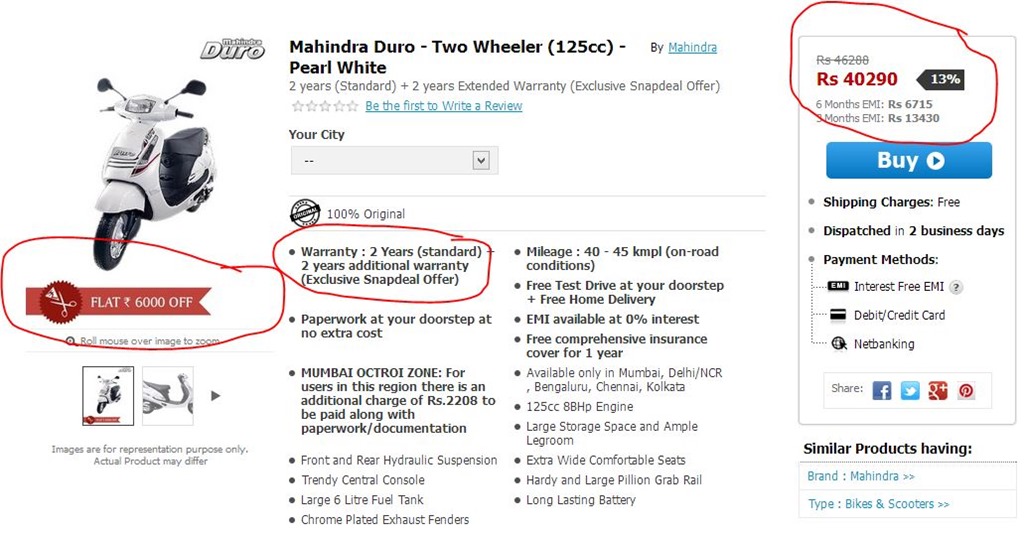
For eg: Mahindra Duo (125 cc) is offered at a price of Rs. 40,900, which includes a discount of Rs. 6000. From what I know, it will be tough for a offline retailer to offer that kind of discount. In addition to this, snapdeal is offering additional 2 years warranty (along with regular 2 years from M&M), which makes the deal all the more appealing for the potential buyer.

mahindra Dua Discount thumb | Snapdeal starts selling Automobiles online!

Also, snapdeal.com customers can buy the vehicle at 0 percent interest rate with 3 and 6 months EMI.

Process for buying Automobile on Snapdeal

  1. Customers will have to call Snapdeal Customer support and book a Test Drive. A Mahindra executive will arrange it in 3 days. Once a test drive is done, you can complete your online purchase.
  2. After online order is placed, Mahindra executive will visit your home to finish the paperwork and formalities.
  3. Within a week, vehicle will be delivered at the door-step of the customer.

Our Take

While, many buyers may not be comfortable buying automobiles online, given that customers are directly in touch with Mahindra executive should put most of the fears to rest. Additionally, the discounts and goodies offered online are quite tempting and customer does stand to save good amount of money.

If Snapdeal and Mahindra are able to execute the entire process of buying and delivery of vehicles smoothly without delays, I am sure the trend of buying automobile online will catch one.

Would love to hear what the readers think of this?

[Note to Snapdeal: You guys need to put the prices of vehicles correctly. While on the listing page (see first screenshot) the price shown is Rs. 45,590/-, if you visit the actual product display page (see second screenshot), it shows Rs. 40,290/-. That is really a serious mistake!]

The post Snapdeal starts selling Automobiles online! appeared first on India Business & Technology Buzz.


Things you can do from here:


Online Shopping Trends in India in 2013


Sent to you by vishal via Google Reader:


via Trakin' the india business buzz by Arun Prabhudesai on 2/2/13

Google has released a video depicting the online shopping trends in India currently and what is expected of the online shopping growth in future. The video is based on Google search trends data and consumer research that happened in collaboration with Analyst firm TNS.

online shopping growth trends thumb | Online Shopping Trends in India in 2013 [Google Video]

According to the findings, 2012 turned out to be the inflection point for Online shopping in India, where Indian online users went beyond online tickets, which was traditionally the most popular category for ecommerce in India. Online shopping grew by over 128 percent in 2012 compared to previous year.

Online Shopping Trends Research Highlights

  1. 9 out of 10 online buyers will spend more money in 2013 as compared to previous year.
  2. Non Metro buyers are increasingly buying online with their contribution increasing much more than the metro online buyers.
  3. Online buyers will use Mobile Phones and tablets more to make purchases online than what they did previously.
  4. Among the all categories, Apparels and accessories category witnessed the most growth and it will surpass even electronics in 2013.
  5. As compared to electronics, emerging categories like baby products, health and nutrition are seeing more growth
  6. Travel and ticketing will remain the most popular category for purchases in 2013 and beyond. Most of the new shoppers have made purchases in travel category first and then moved to other categories
  7. Top drivers of online shopping growth are faster delivery, Cash on Delivery facility, discounted rates, access to branded products and cash-back guarantee on faulty goods.
  8. Top reasons that prevented online buyers from making purchases online were inability to touch and feel, inability to return goods, longer delivery times, need for posting financial details and inability to bargain
  9. Gaining consumer trust remains one of the most important drivers for online shopping growth in India

Online Shopping Trends Video

The post Online Shopping Trends in India in 2013 [Google Video] appeared first on India Business & Technology Buzz.


Things you can do from here:


15 Apps Every Entrepreneur Should Have!

15 Apps Every Entrepreneur Should Have!
Source: trak.in
This is a collection of some of the most essential apps that entrepreneurs should have in their kitty!
 

Wednesday, January 2, 2013

Want to Break Habits? Make Some

Coming out of a habit is not an easy task. All of us have habits that we want to get away from - but its hard! I was listening to an HBR ideacast few days ago and really liked some thoughts. The idea behind the whole thing was that its not as important to feel bad about your habit and convince yourself that "I will not do it". But, it is important to train yourself on "This is what I will do" when I am about to become the victim of my habit. So, if you want to quit cigarette  - don't convince yourself again and again on "I wont smoke next time". But, tell yourself what will you do when you want to smoke - i.e. train yourself on "I will chew a gum" next time I want to smoke. This trains the mind that the right sequence to follow is not to smoke but to chew a gum. Soon, you mind will be asking for gum and not smoke.

So, break the bad sequence by training yourself on an alternate sequence and not by simply stopping to do the old one.
Using Social Media for Sending Wishes

I got up in the morning thinking that because I will have have more time this year, why not start the year by hand-picking people and sending them a "twitter" like (super short - less than a sentence) personal note to wish them on new year. We all know that nothing parallels hand written note. But, still, people these days understand that it will be hard to write and mail 100 cards on every event. However, did you ever try posting on your linkedin or facebook "Happy New Year" and watch how many people respond back to you. I tried that shortcut over the last couple of months and was surprised that I seldom get a response from people! However, today, the response rate was almost 60-70% ( I gave benefit of doubt to some others who must still be on vacation or are on a different time zone).

This painted a picture for me. It feels like using so called "Social Media" to say "Happy New Year" resembles something we all probably did at some point in our lives. I still remember putting up a string with weaved paper alphabets that collectively meant "HAPPY DIWALI" right above the front door of my house. In retrospect, hanging that string in front of my door did not automatically mean anything to people. Infact family/friends who did not visit me that day (or for the next 2 days) did not even see that sign because it was gone by then. So, if I wanted to wish someone, I had to visit them or atleast call them. I feel putting that "sign" against your Social Media handles is exactly like that. It does not mean anything to anyone - except that is shows you are happy - only to people who visit your page before that sign is buried under other updates. There is no personal touch to it and hence you hardly get a response. So, while social channels are good push medium for us in general (we update and others get to know) it certainly does not act that way when we want to push wishes. 

So, I think a short simple email is definitely much more personal and should be used - instead of putting up signs on social media.

Sunday, September 16, 2012

American Football Teams

AFC East
Buffalo Bills - New York
New York Jets - New Jersey
Miami Dolphins - Florida
New England Patriots - Massachusetts

AFC North
Baltimore Ravens - Maryland
Cleveland Browns - Ohio
Cincinnati Bengals - Ohio
Pittsburgh Steelers - Pennsylvania

AFC South
Houston Texans - Texas
Indianapolis Colts - Indiana
Tennessee Titans - Tennessee
Jacksonville Jaguars - Florida

AFC West
Denver Broncos - Colorado
Kansas City Chiefs - Missouri
San Diego Chargers - California
Oakland Raiders - California

NFC East
Dallas Cowboys - Texas
Philadelphia Eagles - Pennsylvania
Washington Redskins - Maryland
New York Giants - New Jersey

NFC North
Minnesota Vikings - Minnesota
Green Bay Packers - Wisconsin
Detroit Lions - Michigan
Chicago Bears - Illinois

NFC South
Tampa Bay Buccaneers - Florida
Atlanta Falcons - Georgia
New Orleans Saints - Louisiana
Carolina Panthers - North Carolina

NFC West
Arizona Cardinals - Arizona
St. Louis Rams - Missouri
San Francisco 49ers - California
Seattle Seahawks - Washington

Sunday, September 9, 2012


Link to Article: https://www.bcgperspectives.com/content/articles/retail_digital_economy_retail_2020_ten_trends/print

Ten Trends That Are Reshaping the Retail Industry
Retail 2020 by Pierre Mercier, Rune Jacobsen, and Andy Veitch August 09, 2012
1. Empowered, Discriminating Consumers. With access to product information, price comparisons, and user reviews, consumers can make informed decisions—and widely share their complaints. For retailers, the bar is rising, and they must add meaningful value to what shoppers can find for themselves, both online and in stores.

2. Ubiquitous Connectivity. With the Internet available at work, at home, and on the go, consumers will be full-time shoppers and most purchases will have some online aspect. Smartphone numbers will be in the billions by the end of this decade.

3. Buying Local, Going Green. Shoppers want to consume in a responsible, sustainable way. They want to purchase from organic and local vendors, and want proof of product origins. But it remains to be seen whether they will pay more for green products.

4. Explosion of Consumer Data. Points of sale, social media, corporate websites, and tracking URLs are generating an enormous amount of consumer data, but few retailers are capable of fully exploiting the potential value of this input. It will take time, because the volume of data is still growing faster than the ability to process it.

5. New Age of Marketing. With more data on customers, their online activities, and purchasing patterns, retailers will be able to create more targeted marketing campaigns—once they figure out how to mine the insights. This will require experimentation and calibration—and consumers will have limited tolerance for misguided marketing efforts.

6. Scientific Retailing. By applying smart algorithms and deep, data-driven analytics to the unprecedented volume of data from multiple sources, companies can optimize all aspects of their business, including inventory levels, pricing, warehouse space, assortments, shelf displays, and staffing.

7. Growing Retailer Power. The top five grocery stores in the U.S. now have a 33 percent share of the market—up from 25.5 percent in 2000. As their spending increases, they have more clout with suppliers. But in several categories, the increased retailer power may tilt toward large Internet players or marketplaces as their growth outpaces the brick-and-mortar competition.

8. Maturing Retail Technologies. A wide range of maturing technologies is allowing companies to streamline backroom functions and increase efficiency, helping to offset higher labor costs. While these are part of the solution for brick-and-mortar retailers, they won’t fundamentally alter the relative economics between store-based and online transactions.

9. Blurring Boundaries Among Channels, Formats, and Brands. CVS is selling fresh food, grocery stores have in-house bank branches, and bookstores have cafés selling Starbucks coffee. Rather than thinking in terms of channels, consumers are simply opportunistic. If they have a need and can fulfill it easily and conveniently, they will.

10.Challenged Store Economics. The rise of online buying is eroding store traffic, forcing retailers to rethink their costly real-estate assets and merchandising formats. How valuable will bricks and mortar be in the future and for what role? Dynamics will play out very differently by category and location.

Wednesday, May 9, 2012

The Most Effective Way to Begin a Sales Meeting - Prof. Wortmann

The Most Effective Way to Begin a Sales Meeting:
Ever had a “groundhog day” sales meeting? You walk away thinking; “Damn, we already had this meeting…we haven’t moved forward. Same old stuff.” We have all made this mistake. Part of it is just plain preparation and being clear on the agenda. But that’s not all. There are two tactics that high-performing sales professionals use consistently; the purpose, benefit, check and pivots. The purpose, benefit, check is the way EVERY sales meeting should open:
“The purpose of our meeting today is to discuss your sales toolkit and how it supports your sales process.
I think this will provide you with a strong sense of how the toolkit could be enhanced to strengthen the sales team (benefit).
How does that sound (check)?
The “PBC” gives you three critical things: aligns your prospect’s expectations with your own, demonstrates that you are prepared and organized, and shows respect for your prospect’s time.
It also points your body down the hill. (What does that mean?) In giant slalom skiing, the racers fly through the gates at high speed. But if you watch them closely, you will notice that their bodies are pointed at the finish line, even as they are subtly shifting their weight to pivot around the next gate. Just like high-performing sales people, skiers know they have to hit all of the gates. They know they can’t miss even one. And they know they have to do this as fast as they possibly can.
Pivots are the same. As mentioned in previous posts, pivots are the transitions you make in a sales meeting to ensure that you are tackling your own objectives. If it is a qualifying conversation (is there any other type?), you are pivoting from budget to timeline, from timeline to decision-makers, and so on. In my experience, sales professionals can make 3 to 4 clean pivots in a sales meeting, and when they do, they walk out having significantly moved the situation forward.
Every sales meeting should be going somewhere. You determine where you want it to go and then you set the course (PBC), pivoting through the gates to get there. As fast as you can.
Have you used “purpose, benefit, check” in a sales meeting? How did it go? Was the meeting more effective because you initiated this process? Let us know via Twitter! (You can also follow Sales Engine CEO, Craig Wortmann, directly!)

Tuesday, May 8, 2012

12 Key Social Media Takeaways

12 Key Social Media Takeaways from Top Social Media Experts


COURTESY socialmediatoday via CMO.COM...
At Instant E-Training we recently concluded our popular “Social Media for Business” WebConference and Certification event. We had over 23 live Social Media training sessions conducted by over 18 leading social media experts. Understandably, there were some pearls of wisdom thrown by all our experts over the course of 6 weeks. So we thought to compile what we thought were 12 key takeaways from our Social Media WebConference event. You can implement these for your business right away. So here are 12 key Social Media takeaways by 12 Social Media experts:
1.Act – If you aren’t getting pushback then you aren’t pioneering – Erik Qualman
Don’t be afraid to try new things and get reactions. Every pioneer makes a bold statement which not everyone always agrees to initially. Often people will hesitate to try new things, but don’t let that discourage you. Act, make bold choices and interact with your audience.
2. It’s not about creating accounts, It’s what you do with them – Krista Neher
There was once a time where companies and organizations created accounts just to say that they had them. Now, it is imperative to use them to connect well with your audience. Make your company one that can be personable and one that people can connect with.
3.Collaboration is necessary for Social Media success– Chris Barger
“No other business strategy executes independently; social shouldn’t either”.
All of your social media efforts should align themselves with the same purpose and remain consistent. Along with that, your whole team should also be on the same page with what their role is in order to work together effectively. Involve your legal team, build social media policies, and keep everyone in the know.
4. Life is not about being liked it’s about being effective – Chase McMichael
The goal with Facebook and social media is not just for people to merely nod their heads in agreement and throw a thumbs up, but to take action. It’s about getting your customer to be actively engaged with your product or organization through social media. You need to have the right content to facilitate the greatest interaction. Find the common interests that your brand’s audience shares and give them what they want. The goal is that through their engagement people would have a great sense of what your company is about and choose you when given the opportunity.
5. Content Isn’t Great Until It’s Shared – Lee Odden
Give your audience something worth talking about. Create content that is music to their ears. You can create this share worthy content via a blog and re-purpose it in many fashions. Participate in the conversations that form and engage the growing network to motivate your audience to share.
6. Twitter Golden rule – Give before you get – Hollis Thomases
You need to give your followers things of value to them. Don’t just ask for a sale – instead give them thoughts, ideas, and tweets worth re-tweeting. You want to give your audience information that is of value to them. It is then that they will pay closer attention to what you have to say. Just don’t expect to receive anything, and give, give, give. If it is done right, you will start to naturally get the attention you want.
7. Figure Out Your Customer’s Dream & Sell them – Brian Carter
Remember that the medium is the message. Something that you might share in an email might not be as well accepted as it would be on a Facebook wall. Whatever it is you share, you want it to be memorable. Selling the dream doesn’t mean the product itself, but rather what it represents for your audience. Sell them awe, connection, belonging, fun, happiness.
8. For small business owners, Word Of Mouth Starts With You– Sima Dahl
For a small business owner, no one is going to retweet for you or share your posts like it usually is the case with big brands. So the conversation starts with you ….Creating memorable moments starts with you. Select a social media channel, assess your content, start a conversation, and be creative. Be a real person with real honest opinions. Find people, engage them, and tell them what you are up to. Encourage the conversations that proceed.
9. Our networks are our most important assets – Neal Schaffer
Our personal and professional networks are the most important assets we have and so we should treat them as so. LinkedIn is a great way to access and form that network. Our network provides us with credibility and possible opportunities. On LinkedIn you can join groups, participate in events and even be introduced to new people that your friends and colleagues know. We have a platform to listen, engage, and connect. It’s simple and a great way to tap into one the most important assets you have.
10. Online Video can help captivate, engage, and stimulate your audience – Bob Tripathi
Videos are great because they captivate the viewer’s attention and stimulate their senses via sight and sound. They keep the viewer engaged. In most cases emotion is easily conveyed and thoughts are easily spread. It can be consumed on a variety of devices, making it also easily accessible. People are able to engage with this media by liking, sharing, and commenting, making this a valuable tool in persuasive efforts.
11. What can be found, can be optimized – Bob Tripathi
If there is any content found on the internet, there is a way to enhance its searchability via the web. Whether it be a blog post, video, or a website be sure to use the right keywords, tags, and phrases to ensure those who go searching will find you. Know what your audience is searching for and how they go about looking for it. There is always a way to enhance your content by way of optimization whether be it your web site, videos, images, or any other digital asset.
12. You cannot qualify a gain without the ability to measure it – Marshall Sponder
Not all social media marketing efforts lead to a ROI. You might need to examine your goals and modify them in order to measure your ROI. Figure out your goals and determine how you will measure progress. The ROI comes from tracking what was invested to execute your plan against the results as outlinedby way of Social Media Key Performance Indicators (KPI’s). Find a practical way to measure and qualify your gain.